By Their Fruits: The Far Right That Calls Itself Christian
From Budapest to Brasília, from Washington to Lisbon: where it comes from, why it grows, how it organizes, and why it fails the test Jesus left.

At almost every rally the same words appear: God, country, family, freedom. Those who hear them in church recognize them and trust. This series asks a simple question, the same one Jesus told us to ask: what are the fruits? Not what they say, but what they have done — with a date, with a name, and with the source beside it.
This is the opening article. It explains where this movement comes from, why it grows, how it organizes itself, and why, measured by the rule of the Gospel, it is not what it claims to be. The following articles look at each leader, one at a time.
1. It is not the same thing as Nazism — but it has deep roots
It would be dishonest to place today's politicians alongside Mussolini, Hitler, Franco or Pinochet. Mussolini dissolved the Italian parliament and used gas against civilians in Ethiopia. Hitler led the genocide of six million Jews and millions of other victims. Franco shot opponents by the thousands. Pinochet left more than three thousand dead and disappeared and tens of thousands tortured. Today's leaders were elected and govern, in general, within institutions that still function — and that is precisely what gives them legitimacy in the eyes of those who support them.
But ideas have a history. The slogan «God, Country and Family», so often repeated in Brazil, was not born in the Bible: it was the slogan of the Brazilian Integralist Action, founded by Plínio Salgado in 1932, in the image of European fascism. Its militants wore green shirts and gave the raised-arm salute. Ninety years later, the slogan has returned — with the same promise of a nation of one God, of one model of family and of one party of patriots, with everyone else left outside.
2. Why it grows now
Scholars point to several causes that add up, and none of them is religious:
- The industry that closed. Globalization carried factories far away and left entire regions with the feeling of having been «left behind».
- Public services that shrank. Years of austerity made the scramble for a doctor, a house or a school place harsher. This is where the talk is born that support should be «for our own only».
- The fear of immigration. The arrival of refugees and immigrants was presented as a threat to jobs, to safety and to identity.
- Weariness with the centre. The traditional parties, on the left and on the right, lost the confidence of many people.
- The strategy of normalization. The new leaders traded openly extremist symbols for themes like the cost of living and security — and so reached the moderate voter.
And there is one cause this blog knows well: the algorithm. Social networks reward indignation, the short phrase and the easy enemy. Whoever shouts loudest reaches furthest — and when the shout comes wrapped in a verse, it reaches the church group too. This is the central theme of The Altar and the Algorithm.
3. They are not isolated cases: it is a well-organized network
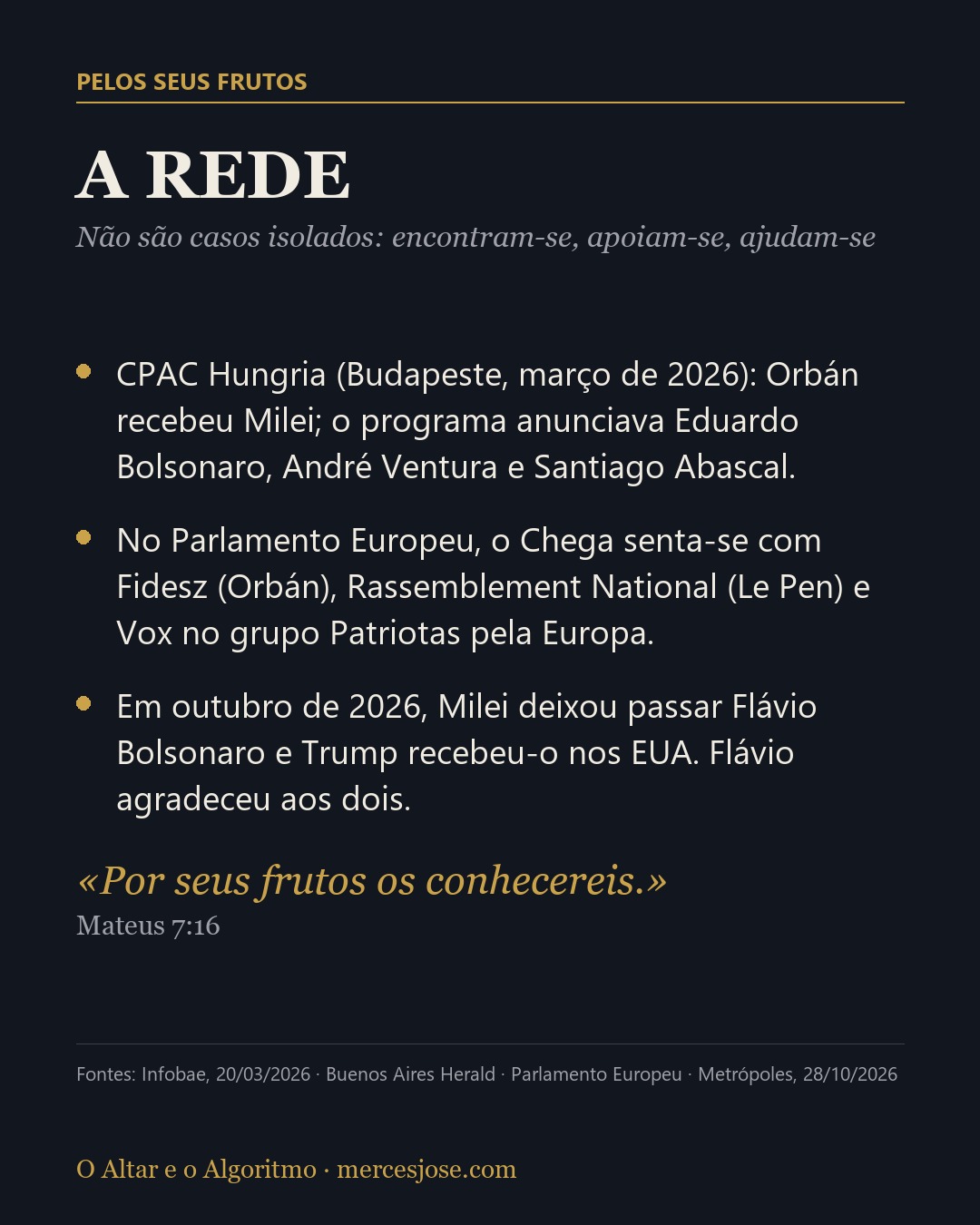
Trump, the Bolsonaros, Milei, Orbán and Ventura do not merely think alike. They meet, exchange strategies and help one another.
- Budapest as a bridge. Viktor Orbán, Prime Minister of Hungary, turned his country into a laboratory for what he himself calls «illiberal democracy» and into the bridge between Trump's movement and the European radical right. Every year he hosts CPAC Hungary, the European version of the great American conservative conference. In March 2026, Javier Milei spoke there, and the programme announced Eduardo Bolsonaro, André Ventura and Santiago Abascal of Spain's Vox.
- A group in the European Parliament. Chega sits with Orbán's Fidesz, Marine Le Pen's Rassemblement National and Vox in the Patriots for Europe group, which advocates less power for Brussels, more closed borders and, in several of its parties, less support for Ukraine.
- Help when it is needed. In October 2026, Flávio Bolsonaro lost the election, refused to recognize the result and left Brazil by night, despite being barred from leaving the country. Milei's Argentina let him through; Trump's United States received him, and according to the New York Times the plane itself was arranged from the White House. Flávio thanked them both.
There were also those who spoke of Fernando de Noronha. What exists, to this day, is a 2025 report that people close to Trump had informally sounded out the military use of the bases at Noronha and Natal, invoking a «historic right» from the Second World War. Brazilian military officers called it «legally unviable» and there was no official confirmation. It is recorded as an inquiry, not as a fact. The UN Charter, in its Article 2, prohibits the threat or use of force against the territorial integrity of any State.
4. The marks of a religious sect
I use the word carefully. I do not use it to insult a church, nor the people who voted. I use it to describe a system that works the way sects work:
- A leader who does not err. They call him «myth»; whoever points out a mistake of his becomes an enemy.
- An absolute enemy. The opponent is not someone who thinks differently: he is a «communist», an «enemy of God», someone who can be «shot».
- Closed information. Only what arrives through the movement's groups is believed; everything else is «the bought press».
- Punishment for those who think differently — at work, in the family, in the church group and, in extreme cases, with their lives.
- The name of God to justify all of this.
The facts confirm each mark. In 2022, the Brazilian Labour Prosecutor's Office received 2,838 complaints of employers who threatened dismissal or promised bonuses because of the vote — almost thirteen times more than in 2018, mostly in favour of Bolsonaro. A transport company in Paraná was convicted for presenting the election to its workers as a «spiritual war». And in the same campaign there were Lula voters murdered by Bolsonaro supporters because of politics, with the perpetrators tried and convicted — I tell that story in the article on Jair Bolsonaro.
5. Who conserves what
It is said that the far right is conservative. To conserve is to keep what exists and has value. Brazil has a Constitution, written in 1988 after twenty-one years of dictatorship; it has ballot boxes that have counted votes for thirty years without a proven fraud; it has a simple rule: whoever loses hands over power.
Those who tried to tear up that rule were not the left. It was the movement that lost in 2022 and, on 8 January 2023, destroyed the Congress, the Planalto and the Supreme Court; whose leader was convicted in 2025 for attempting a coup; and whose 2026 candidate left the country by night instead of accepting defeat. On the other side, when the courts convicted Lula in 2018, he turned himself in to the police and spent 580 days in prison, until the Supreme Court annulled the convictions in 2021. And the family, so often invoked, is conserved with food on the table: in July 2025, the UN announced that Brazil had left the Hunger Map once again.
By this criterion — the only one that matters in a democracy — it was the others who conserved what the «conservatives» wanted to destroy.
6. The test of the fruits
In the articles of this series I look at each one with the same measure: what is proven in court, what is documented by the press and what is still under investigation — and I also record what is favourable to them, when it exists. There is no need to exaggerate. The facts are enough.
«Ye shall know them by their fruits. Do men gather grapes of thorns, or figs of thistles?»
Matthew 7:16
This article is part of the series that accompanies the book The Altar and the Algorithm — How to Identify the New Merchants of Faith. The rule is the same as the book's: separate the proven fact from the suspicion and from the denial of the defence, and put the source beside every statement.
The series «By Their Fruits»
- The far right that calls itself Christian
- Donald Trump
- Jair Bolsonaro
- Eduardo and Flávio Bolsonaro
- Javier Milei
- André Ventura
Sources
- Infobae — Milei arrives in Hungary to speak at CPAC (20/03/2026)
- Buenos Aires Herald — Milei in Budapest with Orbán
- CNN Brasil — Brazil investigates Argentina's and the USA's role in Flávio's flight (29/10/2026)
- CNN Brasil — Trump adviser provided jet for Flávio, says NYT (29/10/2026)
- DefesaNet — USA and access to Fernando de Noronha and Natal (2025)
- Congresso em Foco — Electoral harassment 13 times greater than in 2018
- Vermelho — Labour Court convicts businessmen for pro-Bolsonaro electoral harassment
- O Povo — Brazil leaves the Hunger Map (28/07/2025)
Articles
Comments (2)
-
Júlio CésarExistiu uma faze anterior ao nazismo que se encaixa bem na definição do bolsonarismo na atualidade, que foi o fascismo na Itália.
- JOSE PEREIRA DE MERCES AutorExatamente. É uma distinção histórica fundamental. O fascismo italiano apoiava-se fortemente no culto ao Estado, na retórica nacionalista de regeneração e nos lemas morais tradicionais, sem o componente biológico e o extermínio industrial do nazismo alemão. É por isso que as dinâmicas de poder de hoje se espelham muito mais nesse modelo corporativista e identitário do que naquilo que aconteceu na Alemanha.